Think Big, Think Medium, Think Small
Think Big, Think Medium, Think Small
Be stubborn about your destination, but be flexible about your route.
Technology investments have a much shorter shelf life than they once did. The tool you bet on last year might be irrelevant this year. The platform your competitor swears by might not exist in eighteen months. If you're not careful, this constant churn can leave you feeling like nothing is stable — like you're rebuilding your business from scratch every few months.
But here's the thing: not everything is supposed to change at the same speed. The mistake most businesses make isn't reacting to change too slowly. It's failing to notice that different parts of their business are supposed to move at different speeds in the first place.
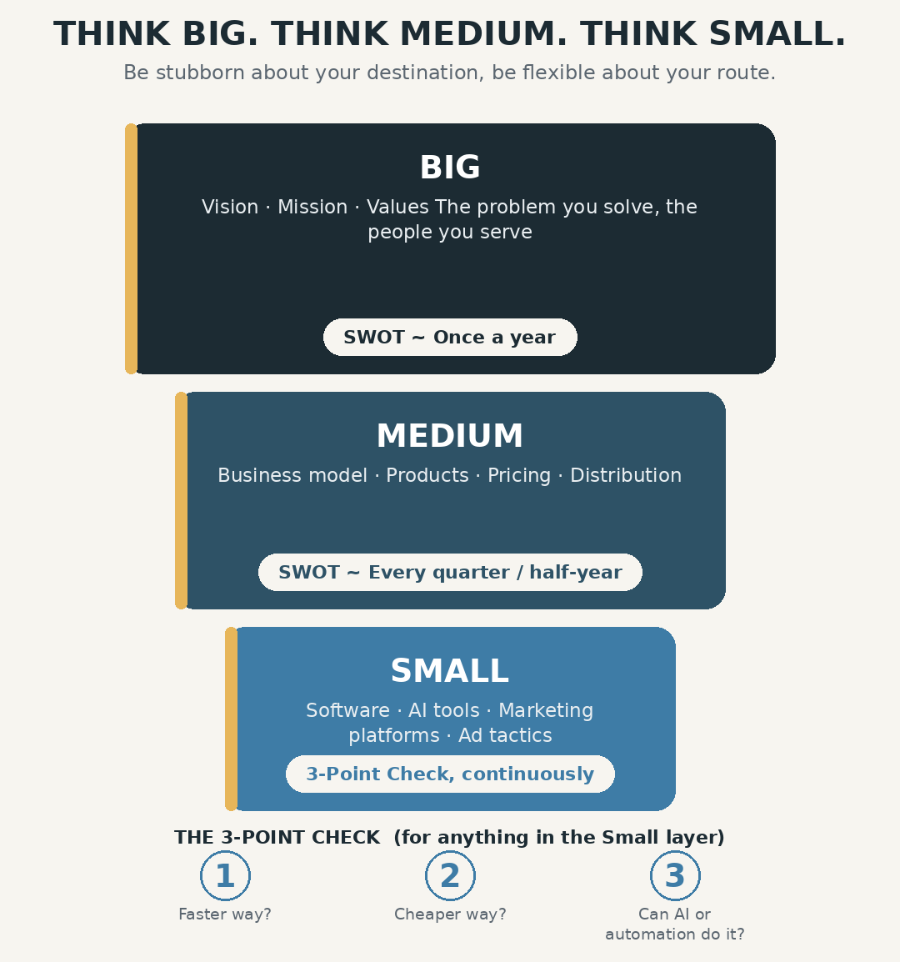
A useful way to think about this is in three layers: Big, Medium, and Small.
Think Big: Things That Rarely Change
At the top sits everything that defines why your business exists. Your vision, your mission, your values. The core problem you solve, and the people you serve.
These shouldn't change often — maybe once every few years, if ever. If you find yourself rewriting your mission statement every quarter, that's usually a sign of confusion, not agility.
Think Medium: Things That Change Every Few Years
One layer down is the how. Your business model, your product and service lineup, your pricing, your distribution channels. These evolve — but on a timeline of years, not months. A shift here is a real strategic decision, not a routine tweak.
Think Small: Things That Change Constantly
At the bottom is everything tactical: the software you use, the AI tools in your stack, the marketing platforms you post to, the advertising tactics you run. This layer is supposed to churn. New tools appear monthly. Old ones get replaced without much ceremony. Treating this layer with the same weight as your mission is how businesses end up either paralyzed by too many small decisions, or emotionally overinvested in a tool that's already being outpaced.
Matching Your Review Cycle to Each Layer
Once you separate these three layers, a practical question follows: how often should you actually check in on each one? This is where a classic tool — SWOT analysis (Strengths, Weaknesses, Opportunities, Threats) — becomes far more useful when you stop applying it uniformly and instead match its frequency to the layer you're reviewing.
Think Big situations deserve a SWOT roughly once a year. Is your mission still relevant? Is the problem you solve still the problem people have? This is a slow, deliberate exercise — not something to revisit every sprint.
Think Medium situations call for a SWOT every quarter or half-year. Your business model, pricing, and channels need regular enough scrutiny to catch drift before it becomes a crisis, but not so often that you're second-guessing a decision before it's had time to work.
Think Small situations don't need a formal SWOT at all. They need continuous, lightweight improvement. For this layer, a simple four-point — well, really three-point — check works better than a full strategic exercise. Before you invest more time, money, or attachment into any small-layer tool or tactic, ask:
- Is there a faster way?
- Is there a cheaper way?
- Can AI or automation do this instead?
If the answer to any of these is yes, that's your signal to move — no need for a quarterly review to tell you what's already obvious.
The Takeaway
Most of the anxiety around "keeping up" with technology comes from applying Think Big thinking to Think Small problems. You don't need to agonize over which AI tool or ad platform to commit to for the next five years — that layer is designed to be replaced. Save your conviction for the layer that deserves it.
Be stubborn about your destination. Be flexible about your route.